
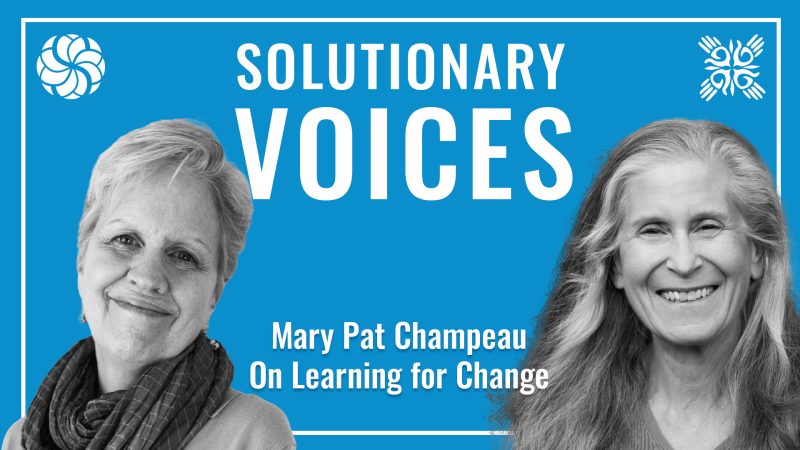
Mary Pat Champeau On Learning for Change
Prefer to Read? Here Are the Key Points from This Episode
Mary Pat Champeau, Director of the Humane Education graduate programs with the Institute for Humane Education and Antioch University, brings decades of global teaching experience spanning education with refugees, cross-cultural learning, and systems-based pedagogy. Her work focuses on preparing individuals to think critically, ethically, and systemically in response to complex global challenges. This conversation underscores why education must evolve beyond knowledge delivery into a practice that cultivates awareness, responsibility, and transformative thinking. In her conversation with Zoe Weil, she discusses:
- Relearning How to Think, Not What to Think: Mary Pat emphasizes that the core failure of traditional education lies in its focus on delivering answers rather than cultivating inquiry. She reframes education as a process of learning how to think—questioning assumptions, analyzing systems, and developing intellectual independence. This shift moves learners from passive recipients of information to active participants in shaping understanding.
- Global Experience as a Lens for Systems Awareness: Drawing from her time working in the Peace Corps, in refugee camps, and at the World Trade Institute, Mary Pat illustrates how exposure to diverse environments reveals the interconnected nature of global systems. These experiences challenge narrow worldviews and make visible the ripple effects of social, economic, and environmental decisions. Her perspective reinforces that systems thinking is not abstract; it is grounded in lived, human realities.
- Curiosity as a Discipline, Not a Trait: Rather than treating curiosity as solely innate, Mary Pat presents it as something that can be intentionally developed and sustained. She highlights how educational systems often suppress curiosity through rigid structures and predetermined outcomes. Reclaiming curiosity becomes an act of intellectual and ethical responsibility, requiring both practice and courage.
- The Role of Moral Imagination in Education: Mary Pat introduces moral imagination as the ability to envision solutions that do not yet exist and to consider the broader impact of decisions on people, animals, and the environment. This capacity extends beyond empathy; it requires structured thinking about consequences and alternatives. In this sense, education becomes a space for imagining and designing more humane systems.
- Education as a Catalyst for Systems Change: At its highest potential, education is not preparation for participation in existing systems, but a force for transforming them so that they are more humane, just, and healthy. Mary Pat underscores that learners equipped with critical thinking and systems awareness can identify root and systemic causes rather than simply symptoms. This redefines education as an active driver of change, rather than a mechanism of continuity.
View all recent Solutionary Voices episodes.